Music Education Market Trends in 2026 and Beyond
This article examines current music education market trends, including growth in private piano lessons, online instruction, and structured music schools. The global market for music education — particularly private instrumental instruction — is experiencing steady expansion driven by parental demand for high-quality enrichment activities, technological accessibility, and growing awareness of the cognitive benefits of structured music study.
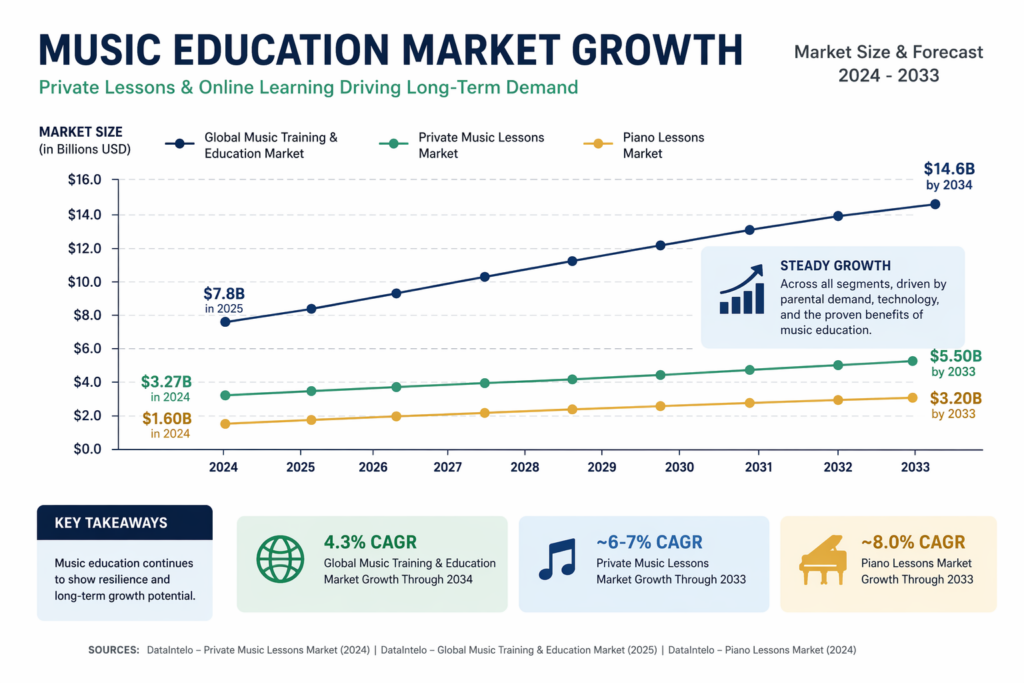
Moreover, recent research estimates the global private music lessons market at approximately $3.2–3.3 billion in 2024, with projected growth toward $5.5–6 billion by 2033, representing sustained long-term demand1.
Meanwhile, the broader music training and education market is estimated at $7.8 billion in 2025, expected to reach $14.6 billion by 2034, reflecting increasing global participation in structured musical study2.
Consequently, for entrepreneurs, educators, and investors, these figures indicate a stable and growing sector positioned at the intersection of education, arts, and professional training.
The Size of the Music Education Market
Global music education demand continues to expand
Music education has historically demonstrated resilience across economic cycles due to its dual identity as both enrichment and skill development. Parents consistently prioritize activities that promote discipline, intellectual development, and creativity.
Key industry indicators include:
- Global private music lessons market valued around $3.27 billion in 20241
- Projected market growth of approximately 6–7% CAGR through 20331
- North America represents roughly 34% of global music training revenues2
- The U.S. private lesson sector alone estimated near $800 million annually3
Unlike many industries influenced by rapid disruption, music education benefits from multi-generational continuity: parents who studied instruments themselves often seek similar opportunities for their children.
Piano Lessons Remain the Cornerstone of Private Music Instruction
Piano study continues to anchor enrollment demand
Current music education market trends suggest stable long-term demand for structured instruction, particularly in piano education and early childhood musical training. Among instruments, piano maintains a uniquely strong market position due to its versatility and foundational role in musical literacy.
Market research suggests:
- The global piano lessons market reached approximately $1.6 billion in 2024, with projected growth approaching $3.2 billion by 2033
- Piano instruction continues to represent one of the largest segments of instrumental education offerings
Piano serves as a gateway instrument for many students because:
- it provides immediate access to harmony and melody
- it supports progression into composition, theory, and ensemble work
- it prepares students for advanced study in classical, jazz, film scoring, and contemporary genres
For music schools, as discussed here, piano programs often function as the core around which complementary offerings — violin, voice, guitar, composition, and chamber music — are developed.
Growth of Online Music Education Expands the Total Addressable Market
Digital technology has expanded access to instruction beyond geographic constraints.
Recent projections indicate:
- the online music education market could grow from $3.9 billion in 2025 to over $9 billion by 20314
- some forecasts estimate long-term growth trajectories exceeding 14–17% CAGR5
Rather than replacing in-person instruction, online learning has expanded awareness of music study and increased participation overall.
Hybrid models now allow:
- supplemental theory instruction online
- remote masterclasses with international artists
- flexible scheduling for busy families
- expanded reach for specialized teachers
This blended approach allows established music schools to maintain quality standards while benefiting from increased accessibility.
Why Families Continue to Invest in Music Lessons
Educational research consistently links music study with cognitive and developmental benefits, including:
- improved executive functioning
- enhanced memory and pattern recognition
- increased discipline and persistence
- long-term academic advantages
As public school arts funding fluctuates, private instruction fills an important gap. Surveys suggest that a significant portion of U.S. parents prioritize arts enrichment opportunities, particularly among households with higher educational attainment6.
Music education also aligns with broader parental preferences for structured extracurricular activities that provide measurable progress and meaningful long-term skills.
Market Structure: Independent Teachers vs Professional Music Schools
The music lesson industry remains highly fragmented, with many instructors operating independently.
However, structured music schools, such as a Chopin Academy of Music franchise, offer several advantages:
- consistent curriculum sequencing
- faculty collaboration and mentorship
- performance opportunities
- administrative support infrastructure
- brand recognition and trust
Research indicates that individual consumers represent the largest segment of music education purchasers, accounting for over half of total market demand.
This fragmentation creates opportunity for professionally organized institutions that combine artistic excellence with reliable business systems.
Career Implications for Professional Musicians
For highly trained musicians, the music school sector represents an increasingly attractive career path.
Traditional academic positions remain limited relative to the number of qualified graduates, while demand for private instruction continues to expand steadily.
The U.S. employs approximately 123,900 music teachers, with continued projected growth over the coming decade7.
Many professional musicians now pursue hybrid careers combining:
- teaching
- performing
- adjudicating competitions
- conducting masterclasses
- directing educational programs
Professionalized music schools provide infrastructure allowing artists to focus on pedagogy and artistic development rather than administrative burdens.
Outlook: Long-Term Stability with Measured Growth
Across multiple independent research reports, the music education industry demonstrates:
- steady growth projections
- strong consumer demand
- expanding global participation
- increasing integration of technology
- sustained parental prioritization of arts education
While short-term fluctuations may occur regionally, the long-term trajectory remains positive due to the enduring cultural value of music training.
The continued growth of private music schools suggests that structured, high-quality instruction will remain an essential component of arts education ecosystems worldwide.
Music education occupies a unique position among educational services: it combines intellectual rigor, artistic expression, and measurable skill progression.
As demand continues to grow globally, professionally structured music schools are well positioned to provide meaningful opportunities for students, educators, and entrepreneurs alike.
The combination of stable demand, measurable educational outcomes, and long-term cultural value continues to support the expansion of the private music instruction sector.
Sources
- Data Intelo: Private Music Lessons Market Outlook
- Data Intelo: Music Training Education Market Outlook 2025-2034
- amra & elma: Top 20 Music Training Marketing Statistics 2026 Reveal Massive Global Student Demand Surge
- Mordor Intelligence: Online Music Education Market Size & Share Analysis – Growth Trends and Forecast (2026-2031)
- Skyquest: Online Music Education Market Size, Share, and Growth Analysis
- Musicologie: How Big is the Music Lesson Industry? Is There Enough Demand To Support Multiple Franchise Systems?
- CareerExplorer: The Job Market for Music Teachers in the United States
FAQ
Is the music education market growing?
Yes. Multiple industry reports project steady growth in private music lessons and online music education, with global market expansion expected through at least 2033.
What do music education market trends show for piano teachers?
Recent music education market trends indicate steady global demand for piano teachers, driven by continued parental investment in arts education and long-term skill development.
Is teaching music a stable career?
Demand for qualified music teachers remains strong due to ongoing interest in arts education, extracurricular enrichment, and college preparation activities.
How large is the private music lesson industry?
Estimates suggest the global private music lesson market is valued in the billions annually, with consistent year-over-year growth.
Interested in learning more about the evolving music education landscape?
Explore how a structured music school model can provide artistic fulfillment alongside professional stability.
Visit: chopinmusicfranchise.com